The Porch

I don’t know who invented the porch, but I feel certain it was someone in the South.

A porch in the South is an essential part of any southern home. Furthermore, in the Deep South, most nursing homes worth their salt have large porches. In the cooler evening hours, you’ll still see dozens of rocking chairs, filled with a generation who knew if supper was over, it was porch time.

Long before there were “spaces” to love and remodel, a porch was an add on everyone had to have as a practical part of life in the south.

Screened in porches were a necessity in the long, hot, humid summers. The porch would allow you to catch a murmur of air movement, if you were lucky. Inside, there was nothing but stifling heat. This was long before central air, and the fans you could buy just moved hot air from one spot to another.

The screen protected you from mosquitoes…although the no-seums always managed to get in and bite a spot just out of reach, as you were drifting off in the waning light.

It was a treat as a child to sleep on the screened porch. Yes, it was hot, but the night sounds were near. The thrum of frogs. The whirring of night birds deftly flying by. The deep throated bullfrog bellowing from a nearby pond.

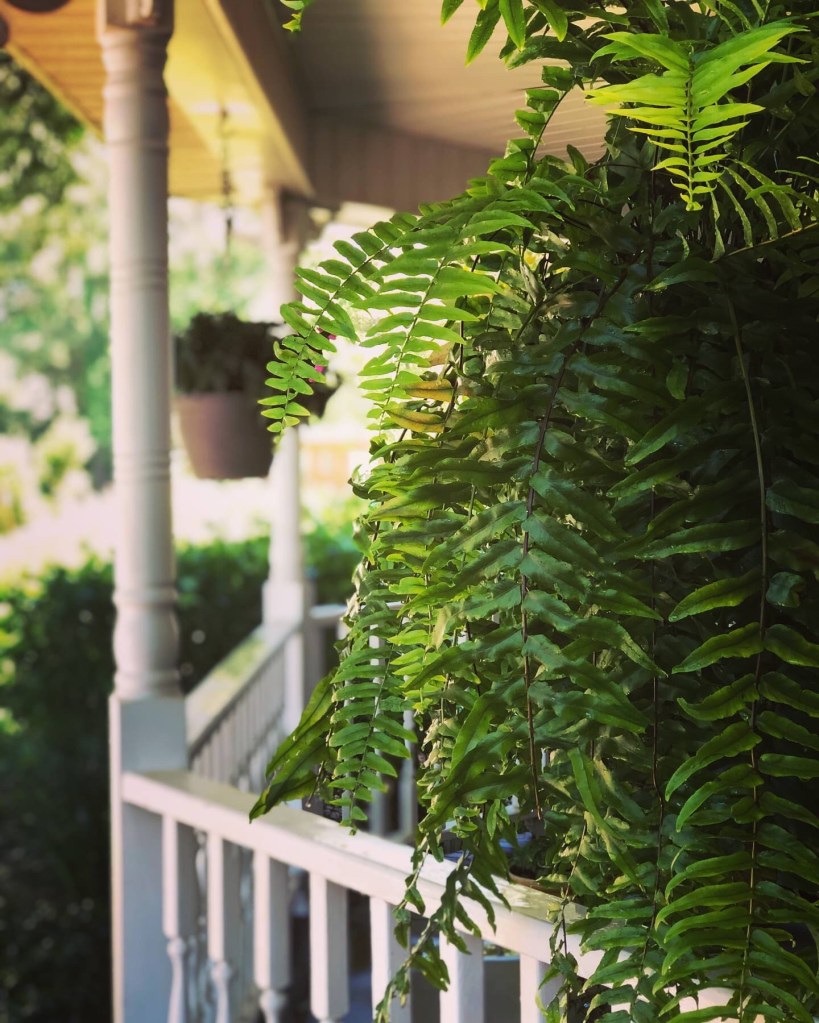
Great, voluminous ferns are a staple on Southern porches. Hanging from the roof, blousing our over a planter, their dark green fronds thrive in humidity, licking up the almost daily misting of water that Gramma sifted over them.

In the South, even the poorest shotgun house has a porch. It only needs to be large enough to hold a couple of chairs. The porch is where Southerners watch the world go by – not that there is much to see. After supper, though, you will find the older ones on the porch, rocking in squeaky chairs that press rhythmically against the bowing porch timber.

In simpler days, a porch was a place to speak to your neighbor as they walk by, causing them to pause and discuss the latest gossip. Or you might just wave at folks as they drove by with their windows down.

Today porches are a lot fancier, I’ve noticed. This traditional Southern necessity has become a status symbol, and many are filled with perfectly matched furniture, knick knacks, and assorted decor. The ferns and plants are replaced every year, because no one can grow them like Gramma could.

With the coming of manicured porches, I’ve noticed people are not actually on their porches. A pretty porch makes for a good show, but ends up standing empty. People enter their house through the garage, and the front door and porch get little, if any, attention.

I’m a throwback to olden times, albeit in a HOA neighborhood. Our house is an older one for this place, and is tucked in the back, around a curve. From my porch, where I can hear the roosters call and the donkeys bray from the road behind our house, I sit in relative seclusion. The dogwood tree, live oak, and rose of Sharon bushes are my camouflage as I sit in the wicker chair. The geranium beside me wafts it’s peppery smell toward me if a breeze coasts by, and I’ll slap at my legs if I feel one of those dad-gummed no-seums.

It’s my place of peace. A refuge. A place to relax and remember a simpler time gone by.

I’m grateful for this Southern porch of mine.

Perilous Times

The world as we know it has forever changed.

I live in Florida, and I have evacuated for major hurricanes more times than I can count. Even more often, I have battened down the hatches and stayed home to ride out the storms.

We knew the storms were coming. We stocked up on water, non-perishable food, and gasoline. We know the routine. I never got flip about this – there were no hurricane parties for us. We evaluated, and made our decision to stay or go based on the facts at hand.

Today, I cancelled all my plans for the forseable future.

We have a pandemic.

I’ve watched the headlines. Most of my info comes from the front line workers – the physicians that I personally know that are working in ER’s and hospitals.

The Chinese Coronavirus has been evolving. The speculators in the media are all over the place. I’m not watching the news.

I will look to the officials who are advising our course of action.

Based on the reports of my medical friends on the front lines, I am in self imposed quarantine. I have asthma as well as type 1 diabetes.

I’ve been watchful. I’ve been cautious. Now I am going to be exceptionally so.

I’m blessed to not have to work right now in my chosen career as an RN. I travel, but that’s on hold indefinitely.

Today the mall closed. The bars and clubs closed last night. Church is now closed until the end of the month. They are contemplating closing restaurants- although, already, most are deeply affected by limits on how close people can sit to each other.

The irony is, while they are seating patrons six feet apart, the wait staff and cooks are tripping over each other in the food prep area.

My family will be deeply hit by the closures of schools and restaurants. Like most people working in those industries, they have little savings, and no other prospects.

I don’t know what’s coming next.

I’m going to continue to monitor the advice…from my home. My husband gets groceries. I cook at home, which is normal for us, but going out to eat is out of the question.

I will not be going to the gym, but I’m outside and exercising more than ever. The stress of this mysterious, nebulous space we are in has me uneasy most days, and anxious others.

I believe in God, and I am praying now more than ever for my family, and for our nation…and the world.

The Great Outdoors

I have been in a funk, off and on, for the past couple of decades.

Oh, for a lot of those years I was very busy with the tasks of raising a family, working full time, participating in all the frantic mom stuff that goes along with a brood of three children.

It was twenty years ago that I moved to a very southern, very humid, very sweltering place.

Here is where my unease began, but I didn’t recognize it…until very recently, when it came to me.

I missed being outside.

I am a child of the seventies and eighties. That mystical age where I would eat my cereal at the kitchen table, and then would dash outside to play. I would reappear for lunch, usually something on Wonder bread and accompanied by Kool-Aid, which was reserved for summer only. Then, I was back outside again. We knew it was time to come home when the street lights came on.

We moved every 1-3 years, averaging every 1-2 years, because my dad was a career USAF officer.

All I know is, everywhere we went, I was outside.

My earliest memories are from my toddlerhood. As a three year old in Montana, I remember making snowmen with my big brother. I distinctly recall to this day coming inside before a storm hit, and sitting in my high chair as the rain and hail wreaked havoc outside the window, while the rain seeped in under the kitchen door, onto the yellow linoleum. Later, I saw the tulips, beheaded by the hail.

We lived in Alabama when I was four, when I was in the fourth grade, and when I was in the ninth grade – all of these were one year tours of duty for my father.

At four, I remember exploring the playground outside the preschool I attended. I found a turtle one time, and spent the hour picking it up and placing it somewhere else, only to watch it slowly turn to make its way back to its original hiding place.

In the fourth grade, I rode my bike with my friend all summer, weaving through the streets of our new development neighborhood. The smell of the red clay is always one I associate with summer. On particularly hot days, we would duck under the wild plum tree, listening to the hum of bees as we ate our fill of the juicy, dark fruit. It seemed to me that there was nothing sweeter.

Before the long days of August arrived, we would get tadpoles from the murky puddles left by the tires of the construction equipment. Every morning we would feed the tadpoles dried oatmeal as they wriggled in the plastic shoebox we put them in. We would watch the buds start to develop out of no where on the sides of their bodies, and waited for the legs to grow out, even as the little tails disappeared. Soon they were hopping off to do what toads do – but not before we examined every amazing feature of their perfect little toad bodies, no bigger than the end of our thumbs.

By ninth grade, I was not tolerant of heat, and spent most of my summer indoors, sitting in the window seat and reading.

Fifth and sixth grade were spent in the Midwest. These were the summers of kick the can, and of exploring the creek. We would wade into the ankle deep water, looking for crawdads. One time the creek widened into a chest-deep pool of mossy green water, and as I bobbed up and down, I saw the eyes of a magnificently huge bullfrog stare blandly back at me. I didn’t go back to that spot, afraid of what else may lurk there.

Seventh and eighth grade were the most adventurous, spent in the Philippines. Every chance I had, I was outside. I had perfected riding a 10 speed bicycle, and spent hours going though the neighborhood, using no hands, but only my young body to steer me. In the dry season, I would make leis out of the plumeria trees that were everywhere – pink, white, dark purple, and I would be intoxicated by the heavily perfumed flowers that I draped around my neck.

We went to Grande Island regularly, where there was a coral reef just offshore. I loved to snorkel out to the reef, floating over the world beneath, seeing things I had previously only seen on Jacques Cousteau specials.

In the rainy season, we played in the warm rain, because it was ever present, and we wanted to be outside. When the rain stopped, the earth would let off steam from the heat. We walked carefully, always barefoot, because we knew the snakes came out when it rained.

Riding in banca boats, we set off from shore to isolated islands, exploring what seemed like the ends of the world. We also went to the mountain forests of Baguio, amazed at the difference of our surroundings now – tall evergreens permeated our senses with their spicy needles and towering presence. Most of my memories of the Philippines were times spend outdoors.

My first through third grade, and tenth through twelfth grade, were spent in the shadow of the Wasatch front.

Here is where I found my true love, the mountains. I had been through mountain ranges before, but never lived on the side of the mountain. We lived by the mouth of a canyon, and I learned how to drive along that twisting, narrow path that mirrored the river that had carved the canyon itself.

Here, I loved every bit of being outside. The air up there is different – clearer, cleaner. I would crank open the window every time we went up the canyon, and I smelled as well as felt the temperature change as we ascended.

Many weekends were spent camping in the pop-up camper. Sunburns came as we played thoughtlessly in the woods, or fished in the lake. Nights around the fire , I watched the sparks shoot up toward the sky, unable to match the majestic fir and pine trees that huddled over our camp, keeping out the sounds of civilization far from our secluded camp site. I would lie on the ground and watch the stars, completely overwhelmed with the smallness of my life.

Closer to home, the river was tame and low in the summer, and I would step across it on a path made of smooth river rock. It was enough to sit there and watch the sun dapple and dance on the water as it glided over and under the branches and stones.

My dad had a love for the outdoors, and we vacationed in some great national parks – Arches, Bryce, Canyonlands, Zion. We drove the breathtaking road from southern Utah to the north rim of the Grand Canyon one fall, the golden quaking aspen showing its glory through the deep evergreen groves. The fields were rolling and amber on both sides of us, and the beauty was almost too much to take in.

We also explored Yellowstone, and the Grand Tetons. These were healing and heady times that are etched deeply into the soul of my memories.

Two decades ago, I moved to a place I didn’t want to be. Hot, humid, and sultry doesn’t begin to describe the oppressiveness of summer…and of the weather for more of the year than any other descriptor. I retreated to my house when I was not working. I only went outside on the rare occasions the heat index allowed, and even then, I limited my time outside, to protect my fair skin from the sun.

A few years ago, I began running. I hate the dreadmill, so I went outside, on purpose, more regularly.

I hated it for a while. The oppressive humidity makes my whole body slick with sweat almost immediately and I, used to the dry air of the mountains, resented it. Adding to the misery, great clouds of gnats would appear out of nowhere, and there is no outrunning them once they find you. I’d have to run with my mouth closed tight to keep them from being inhaled, and they stuck to my sweat slick skin from head to toe, as if to spite me

I hated it here.

Then I started to have a realization…

I am here, I live here, and even though I made escapes to cooler and more mountainous climates as often as I could, the majority of time, I was “stuck” here.

I better make the best of it.

I began to look around me as I ran. I began to see things with new eyes.

The abundance of flowers, year round. The bright yellow forsythia of spring, pale in comparison to the chaotic riot of fuchsia azaleas that are everywhere, especially loving the wild oak trees that are native to this part of the state. Wisteria climbs through trees and vacant lots, looking like lavender bunches of grapes, and smelling like the sweetest perfume. Redbud blooms shy and pink, and dogwood trees lay out their fragile white or pink blooms in fragile, horizontal planks.

Summer bring the big, beautiful magnolia blooms, subtle in scent, but stunning in size and beauty. Riotous roses are everywhere, thriving in this climate that I so resist.

The birds – so many birds! Spring is overflowing with bluebirds, house wrens, robins, finches, and delicate, migrating hummingbirds. Overhead, osprey, hawks, and even the occasional bald eagle soar by regularly.

All this in my suburban neighborhood.

Suddenly, I wasn’t just running. I was looking forward to spending time outside, to commune with all the beauty I had run or driven past, in my determination not to bloom where I was planted.

I am a child of the outdoors, and I am finally deeply aware of this.

I must tend to her.
Cozumel – Leap Day

It’s too windy to go into the water today. Our shore excursion to Passion Island was cancelled due to rough seas.

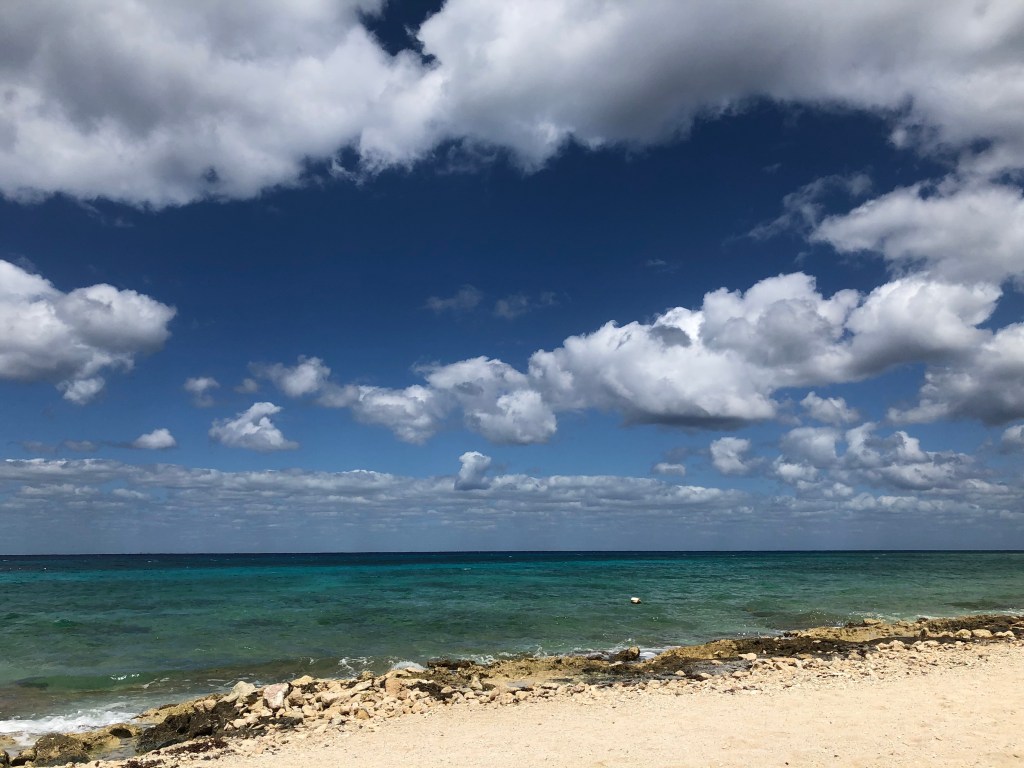
Instead, I’m sitting at a private resort on a canvas lounge chair, watching the ocean shift from green, to blue, to sapphire, with turquoise-streaked though out, and the whole of it tipped with white caps.

The waves gush up the coral strewn beach. Pools of sea water magnify the ancient remnants of crustaceans. Occasionally, the ocean will press through the rocky fringe like miniature geysers, and the sea mist will ride on the wind to my outstretched legs.

Sea birds circle above, black silhouettes gliding in circles against the clouds drifting above me. I wonder what the species is, and what they are seeing.

A mariachi band is playing off in the distance, completing the soundtrack of wind and wave and music on my Mexican vacation.

As I get up to stretch, I find the almost impossibly vibrant fuchsia bougainvillea waving in the stiff breeze. I always take multiple picture of this tropical paper flower, seemingly impossible for me to grow at home.

My relaxation is only broken by the fellow tourists who walk down to my secluded beach area to take dozens of selfies, or talk on their phones. I put in my AirPods and watch the ocean, turning up my music enough to drown out their voices, closing my eyes to their posing. I can still hear the sea, feel the breeze. As they finally walk off, I turn off the music and return to watching and listening to my environment.

It’s amazing what a few hours on a Mexican beach can do for your soul.

Omission

I used to think of omission as in terms of the sin of omission. The intentional failure to tell someone the whole truth. The “little white lie”. While that is still a defining truth about omission, it is not the only thing about omission that hurts.

Lying, in my opinion, is always bad. I believe the truth always comes out, so lying to cover up or hide something is just a delaying tactic.

Lately, though, a more personal form of omission has been tearing at my heart.

It’s being purposefully left out. Not included. Even excluded.

Life is short. I’ve lost my mother and law and my best friend this year.

There is no respite from that.

It’s been my dream and desire to have a close family.

In many ways, little by little, things have moved in that direction…in some fronts.

In other fronts, distance is growing. The road to frustration and pain is paved with good intentions.

Meanwhile, I busy myself by trying to help others who are going down the road I have trod.

In my local activities, an area where I felt I was thriving and contributing suddenly has changed. I was omitted from any part in an endeavor I was heavily involved in, and no explanation was given.

In the absence of an explanation, the tendrils of doubt and pain have started to take hold.

The hard part for me as an introvert who hates confrontation is I need to go and talk to those involved. Ask why I was omitted.

See if it was intentional.

I do not want to dwell on an offense, when none may be present.

These are the things that happen when you are involved in organizations- even as a volunteer.

It doesn’t make it any easier.

I put a lot of time, care, and effort into this over the last decade.

Which is why I need to go clear the air.

Life is too short to be hurt and wonder what happened.

Friendship

One of my dearest friend has just passed away

She was diagnosed with ALS in May, 2018, at the age of 58.

We were both registered nurses. We knew the sequelae. She had just planned her daughters wedding and successfully waved her off to her new life.

My friend was one of the funniest people I have ever known.

She had a rough childhood – some of her trauma was a shared story we commiserated over, but never let it stop us.

She was the room mom. Then the sports mom. The band mom. She was ever the fun, gregarious friend. The choir member. The event planner.

She was the full time RN with a beautiful home, and she still managed to plan lots of fun trips for us to go on to Disney World and Dresden, Ohio when she was a Longaberger consultant.

She loved God, her family, her friends, and America.

She loved to laugh, and we did a lot of laughing. My happiest memories with her involve a lot of laughing – the kind you can’t remember got you started, but left you with tears of joy running down your face.

I have a lot of memories – from the many years we worked together as RN’s. From the times we went fun places, because she included me in so many fun trips. From the decade of luncheons she planned and we worked on with our friends to raise money for breast cancer research.

Since her diagnosis, things went downhill quick. She was able to see the birth of her daughters son this fall, and his recent baptism. I know these events meant a lot to her.

I’m not so selfish to wish her here still, at least not with that wicked ALS. I can’t envision a crueler disease. I’ve prayed every day that she would not suffer.

She’s not suffering today.

I miss you, beloved friend.

I’ll forever be grateful for the twenty years you were in my life.

Shhhh

We’ve become a very loud culture.

Recently my husband and I went to a new restaurant downtown.

It was a nice, yet casual, spot.

We sat on a high top table near a window, and proceeded to endure ear damaging decibels.

A local band? The juke box turned up loud?

Nope. Just the patrons. Talking. Very loudly!!

My nerd husband pulled out his decibel gauge on his phone, and immediately got reading of 80-90 decibels.

80 decibels is equivalent to: Garbage disposal, dishwasher, average factory, freight train (at 15 meters). Car wash at 20 ft (89 dB); propeller plane flyover at 1000 ft (88 dB); diesel truck 40 mph at 50 ft (84 dB); diesel train at 45 mph at 100 ft (83 dB). Food blender (88 dB); milling machine (85 dB); garbage disposal (80 dB).

90 decibels is equivalent to: Boeing 737 or DC-9 aircraft at one nautical mile (6080 ft) before landing (97 dB); power mower (96 dB); motorcycle at 25 ft (90 dB). Newspaper press (97 dB).

(Source: https://www.industrialnoisecontrol.com/comparative-noise-examples.htm)

It doesn’t get better at “nice” restaurants. Gone are the days of quiet, romantic dinners. Instead, I get to enjoy all the conversations around me.

Add a cell phone, and it’s worse. I know that by watching what is going on around me, most people think it’s okay to initiate or answer phone calls, and then talk and guffaw loudly, any time and anywhere.

Wrong.

Cell phones have brought the downfall to a lot of things, and common sense and manners are near the top of the list.

Gone are the days of going to a concert and listening to the musicians.

Now I get to pay $149 a ticket to listen to a millennial shout her inane opinions and describe her sad life. (This happened. And when we asked her to please keep it down, she got confrontational with my husband – a man old enough to be her father).

I would love to see phones banned from restaurants, and concert venues. It was a breath of fresh air to see one of the top comics recently – afraid of people taping the show, they forbid any phone use.

We actually got to enjoy the show.

I used to talk a lot when I was a child. My nickname was “mouth”! I knew when to be quiet, though. I understood the inside voice concept.

As I get older and want to enjoy good food, good company, and sometimes just the great outdoors, I miss the days of quiet.

I hope some how, some way, they can be brought back.

The Purity of a Child

Weary, exhausted, and otherwise frazzled, I returned from a month long trip to Nebraska on Sunday.

I had been helping care for three grandsons under the age of 2. I undertook the journey north eagerly, glad for the opportunity to be there for them while their father was away working for a month.

The youngest, a newborn, started exhibiting colic symptoms almost immediately. I spent many days and nights rocking, patting, and swinging him in my arms, singing songs in hopes to soothe him.

The 22 month old twins and I fully enjoyed fall. We played in the yard, exploring the leaves – ripping them, tossing them in the air, crunching through them. I carved a pumpkin, and they peered inside the fibrous opening over and over, tentatively reaching in with an index finger to explore the slimy, seedy contents.

I also was the catcher of many tackles, giver of endless hugs, and reader of bedtime stories.

It was precious time, over much quicker than I could imagine.

A sixteen hour drive loomed ahead of me Friday, and I was grateful my husband flew up to help me drive home.

Monday arrived after the whirlwind of emotions that came with leaving my midwestern family behind. My heart was more than a little tender, and I missed my grandsons fiercely.

My nine month old grandson here in my home state greeted me with smiles on Monday morning. I was there when he was born, and have watched him every week since, two days a week, since he was born. I missed a whole month with him.

As my afternoon with him neared a close, he finished his bottle, rolling completely around on me, until his head was nestled under my chin, and his arms encircled me in a hug.

For a full fifteen minutes, he hugged me, laying still and quiet. Once or twice, he lifted his head to smile at me, and then resumed his embrace.

Next, he sat in my lap and I made funny faces at him, and we laughed for a full 15 minutes.

It was absolutely therapeutic.

It seemed purposeful, and I don’t know if he missed me, or if he knew how much I needed that sweet baby hug, and his infectious laughter.

I left yesterday afternoon with the balm of sweet innocent baby pure love healing my tender, hurting heart.

I am a blessed Nana, indeed.

The Pumpkin Patch

Last night I went to a large farm in Omaha, famous for its fall festivities, food, and pumpkins.

My daughter and I had a couple of hours to get some one-on-one time. With her three children under two, our hours are concentrated on parenting, and being Nana.

It was a cool day that grew colder as the sun set. We ate our pulled pork sandwiches, made s’mores, and began to traipse around through all the barns on the property.

I had a chance to see, smell, or taste a lot of missed fall favorites. Fresh, hot apple cider donuts, hot cocoa, fresh pumpkin pie (made from real pumpkin!), kettle corn, caramel apples. We ran from shop to shop, filling our eyes and nostrils with the sights and scents.

As we headed for the pie barn, we decided to take a hayride out to the pumpkin patch.

A John Deere tractor pulled the wagon out through the acreage to the lit up pumpkin patch. As we bumped down the dusty dirt road, I breathed deep the smells of fresh turned soil. Manure. Distant wood smoke. The wagon pulled us through the dark, and the night sky began to light up with stars, previously hidden by the city lights.

As we came to a stop, a huge floodlight illuminated the pumpkins in the fields. Large and small, green and orange, smooth and covered in warts, I admired the varieties, and I wandered through the field, stopping to take pictures, and savoring the country experience.

After a few minutes, I got back on to the wagon. Suddenly, I had that clarion moment where I realized I was perfectly happy. My daughter and I were having a good night, and I was in the country, which I love and miss deeply. I was experiencing an Autumn night, with all the wonder that goes with it for me.

My daughter snapped a picture of me while I was in the field, and when she showed it to me, I wept happy tears.

She asked me why I was happy, and I told her it was because I realized how perfectly happy I was. In a pumpkin field. In Omaha.

She’s lost in the heavy baby season – days filled with start to finish with babies, diapers, feedings, and trying to get some sleep.

When I had young children, I was a single mom, working and going to school.

I have large swaths of time where I remember very little, if anything.

I was so busy trying to survive I didn’t get to really live.

Now I’m not working full time – I am a full time wife and Nana.

I can purpose to be grateful, to seize the day, to appreciate the little things.

In that moment last night, I was physically aware of how very blessed I am.

I wept from the joy of it.

Getting Back Up

A few months ago, I started watching my baby grandson a couple of days a week.

As he grew, I wanted him to explore his world. I’d spread out a quilt, and lay him on it, then I would get down on the floor with him, so we could interact.

Though I’m young at heart and appearance, I’m not as young as I used to be. While I got down there easily enough, getting back up was, well, a challenge.

The knee that has never been the same since a fall at work joins the back and joints that are not as flexible and nimble, and have slowed my ascent.

I walk regularly. I do yoga and tai chi. I’m not overweight…I’m just older!

The more important thing for me is getting down there on baby level. Now he crawls, so I crawl around with him.

Today I was with my 22 month old twin sons. As I have since I’ve been here the last couple of weeks, I get down on their level. We play. Wrestle. Laugh!!

Nana just doesn’t jump right back up like she used to.

I always get back up, though.

There are times life has brought me low- either by my poor choices, or just the path I was on.

I’ve struggled with major depressive disorder for almost thirty years.

There are down days – but I know I’ve got to keep moving. Get back up!!

November is the most loaded month of the year for me.

I’m exercising more regularly now, and have started my half marathon training again. Diabetes knocked me down – but I’m getting back up.

I’ll be as prepared as I can be for next month. Praying. Going to church. Loving my family. Being healthy.

I know I may still get down…but I’m not afraid to ask for a hand if I need it, to get back up again, and move forward, one step at a time.

So, friends, I’m up. But there is a perspective and depth to my life I can only get when I’m down.

I just refuse to stay there.